Preserving Glories Past
In Philadelphia, a small group of dedicated volunteers has created a digital museum of rowing history that showcases thousands of the sport’s historic artifacts.
By Dotty Brown
Rowers just want to get out on the water and row. They want to work out. To race. Meanwhile, the pages of old minute books, stored in the back of boathouse closets, fade and turn brown. Logbooks pile up in plastic bins. Banners get eaten by moths. Trophies, thrown into boxes, tarnish and dent.
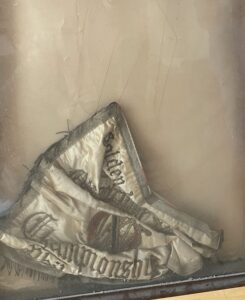
A banner, fallen into its frame and eaten by moths/Dotty Brown
In Philadelphia, a small group of rowing-history buffs are fighting against neglect and the ravages of time. At the finish line after years of effort is a digital rowing museum that is documenting thousands of the sport’s historic artifacts.
The Rowing History Project showcases minute books, trophies, medals, photos, news articles, and videos previously hidden from public view. Illustrated stories on the site take visitors inside moments of rowing history and the people who made them happen.
The museum’s initial focus is on the clubs of Philadelphia’s Boathouse Row and private collections, including the 3,000-plus items amassed by rowing historian Bill Miller. But the museum’s goal is to become a national or even international hub.
“What we wound up with is not a software program designed just for Philadelphia or Boathouse Row.” said Chris Doyle of the Pennsylvania Barge Club. “It’s intended as a national platform. Any boat club, school, or organization could upload to it. Our big contribution is a national platform for rowing history.”
The Rowing History Project (RHP) began as alarms went off for a few history-minded rowers, including myself. The shock for me came a decade ago while researching my book, Boathouse Row. On my dining-room table was an 1890s minute book of the Vesper Boat Club, loaned to me by a rower who was storing it in her house because Vesper didn’t know what to do with it.
Its brown leather cover was dried and flaking, its binder cracked. I paged through it tenderly, awed by the elegant cursive that told long-forgotten stories. Afterward, not knowing what else to do, I wrapped it in layers of plastic wrap to hold its pieces together.
Meanwhile, Rick Stehlik of the Malta Boat Club and Henry Hauptfuhrer, former captain of the Bachelors Barge Club, dismayed by the disarray of their clubs’ historical records dating from the mid-1800s, were working as lone salvagers, but finding little support from their organizations to catalogue and preserve them.
Stehlik, a champion lightweight rower in the 1970s, was “aware of all this stuff squirreled away in filing cabinets.” Fearing people might say, “Let’s throw this all away,” he began Xeroxing. “We were amateurs in the wind.” Soon he realized “the problems go way beyond Malta.”
As a teenager in the 1970s, Hauptfuhrer had won a race at the Stotesbury Regatta and was impressed by the men who 50 years earlier had started a “School Boys Race.”
“Edward T. Stotesbury and Garrett Gilmore were a big deal for me,” he said. “I always loved history.” As an adult, “you start to appreciate the people who ran before you to make the sport possible for you.”
In 2018, hoping to wake up Boathouse Row to the imminent loss of its history, Stehlik and Hauptfuhrer led about a half dozen concerned rowers on a tour of the Malta and Bachelors clubhouses and Bachelors’ upriver social venue, The Button.
“The quantity of stuff is so great, it could fill an entire museum—and many wish a rowing museum could be launched in Philadelphia,” I wrote afterward on my blog.
We worried. What other treasures were moldering in the crannies of Philadelphia’s 19th-century boathouses?
At first, our idea was to alert the clubs to their orphaned artifacts and urge them to find ways to store them properly. But little happened until Covid struck in 2020—the same year the Head of the Schuylkill Regatta (HOSR) had planned to celebrate its 50th anniversary. The shutdown of the regatta was actually the starting gun for the idea of a digital museum, though we didn’t know it then. Nor did we know that a tragedy would touch our project.
With the regatta canceled, HOSR president Ellen Carver and executive director Jennifer Wesson came up with “Fifty Years, Fifty Stories”—monthly Zooms as a way to bring some fascinating rowing history to light and keep the landlocked rowing community together.
They invited the Row’s loose band of historians to plan the story hours. And so began the first of hundreds of brainstorming meetings, every Friday at 11 a.m., that continue even today.
After hosting a story hour about the Philadelphia Girls Rowing Club (PGRC) in 2022, Chris Doyle joined the group. A lifelong rower and coach who had retired to Philadelphia, Doyle had been surprised that Pennsylvania Barge Club members didn’t know its history—for instance, that Ernestine Bayer, the wife of its captain and 1928 Olympian, had helped found PGRC in 1938 when no rowing clubs on the Schuylkill River admitted women.
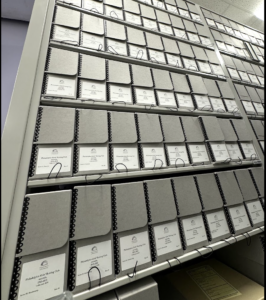
Shelves of documents from Philadelphia Girls Rowing Club at the Historical Society of Pennsylvania/Dotty Brown
Increasingly, conversation at the Friday meetings turned to concern about the Row’s artifacts. Some clubs had put old paper documents into temperature-controlled archives at institutions such as the Historical Society of Pennsylvania and the Independence Seaport Museum, but the clubs had so much more—trophies, plaques, medals, paintings, photos, and news clippings.
The group quickly dismissed the idea of a stand-alone rowing history museum. Filling it would be easy, but where to get the millions to build and staff it? Besides, rowing museums were failing. In 2014, the Mystic Seaport Museum closed a rowing exhibit, with items from the collections of Tom Weil and Bill Miller relegated to storage.
At the same time, the group was jolted into action further by a discovery at the Vesper Boat Club. Former club president Hilary Langer had gone into the recesses of the boathouse to inspect its failing air handlers.
“I couldn’t get to them because I discovered that trophies, plaques, all this heavy stuff, were in boxes piled up on top of them, crushing each other,” the architect said.
“I was so scared. We were so focused on rowing and operating a very, very complicated operation with masters, lightweights, women, heavyweights, juniors, high schools, that all this stuff was forgotten and neglected. It would still be there if those units hadn’t needed replacement. That is a fact.”
Reaching into every cranny and cubbyhole, he pulled out moth-eaten banners, dozens of regatta plaques, some awarded to John B. Kelly, Sr. and other Olympians of the 1920s—a total of nearly 1,000 items. And under a desk in the boathouse office, still encased in my plastic wrap, he found Vesper’s 1890s minute book.
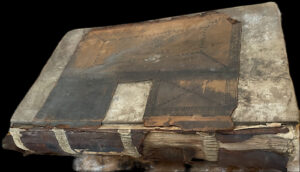
Vesper Boat Club Minute Book , 1890s/Dotty Brown
At a loss about what to do, he reached out to the story-hours group. Spurred by the Vesper crisis, the HOSR published a call to action on its website in August 2023.
The urgency, it said, is that significant amounts of rowing history are perishing, and the goal is to tell the history of rowing “locally and nationally by preserving these objects and making them accessible to the greater rowing community and public.” Among the recommendations: Create “a virtual haven for artifacts.”
But how to do that? What platform to use? What software and technology? How much would it cost? And would the HOSR continue to host the effort?
Years before, HOSR president Ellen Carver, a history buff herself, had done a preliminary inventory of Vesper’s holdings. She believed it was within the HOSR’s purview to support a digital rowing museum.
“The HOSR always said we’re more than a regatta,” Carver explained. Its mission statement states that it works “year-round to give back to the community … lead efforts in sustainability … be stewards of our river … be good neighbors, supporting local businesses, organizations, and endeavors.”
Wesson added, “We stood at a point in time with a real opportunity. It just made sense that with a group who were so knowledgeable and so passionate we could build something that had a home and have staying power.”
Most members of the story-hours group had been competitive rowers, disciplined and determined. They also brought to this new challenge a constellation of career skills—management, architecture, engineering, technology, design, journalism.
Doyle, who had overseen systems development for Mercedes-Benz USA, led the technical side of the project. His first goal was to research a platform for our digital museum. The group consulted with archivists at such Philadelphia institutions as Drexel University, The Athenaeum, the Conservation Center for Art and Historic Artifacts, and PACSCL—a consortium of special-collectionslibraries.
We also met with Margery Sly, an archivist who had run Temple University’s Special Collections Research Center. And Doyle found Walt Rice, a technology consultant in demand by museums yet willing to work with us.
With their input, we settled on Omeka, a web-publishing platform that is open source and used by museums. Plus, it is free. After years of weekly meetings, we had yet to spend a penny. But having engaged Sly and Rice, we now needed money. HOSR contributed $5,000, and its board amended its nonprofit charter to include the RHP, opening the door to tax- deductible donations.
Tony Schneider—a masters rower at Vesper, HOSR board member, and supporter of the urban youth program Philadelphia City Rowing—provided seed funding. Members of the story- hours group also contributed.
The plan was to use Vesper’s inventory— the largest on the Row—as a “proof of concept.” If its images and data could upload to our website, the Rowing History Project would be a go.
Langer had carted hundreds of items, including photos, wooden plaques, silver trophies, logbooks and more, to the sprawling clothing factory of Boathouse Sports, where owner and Olympian John Strotbeck offered space.
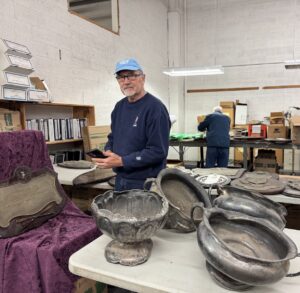
What to restore? What to throw out? Hilary Langer debates future of Vesper artifacts in space made available at Boathouse Sports/Dotty Brown
Beginning in April 2024, Sly and rower volunteers zigzagged past clattering sewing machines to inventory the trove pulled out of Vesper. Each item was entered into a spreadsheet where Sly had replaced jargon-filled archival language with headers that volunteers could understand.
At 11 a.m. on Sept. 26, 2024, Rice pressed a button and uploaded 500 items from Sly’s spreadsheet. Instantly, Vesper’s records and artifacts were visible and searchable. We were on our way—if we could convince other clubs to join in.
By the next summer, Sly and the team, whose Friday meetings now focused on creating the Rowing History Project, were poised to show a demo to the rest of Boathouse Row. Just then, Sly learned she had cancer. Within three weeks, she was gone. We mourned; Sly had become a collaborator and a friend—and the only one onboard who knew how to categorize objects for the website.
Searching for another archivist willing to use laymen’s terms, we recruited Kaitlyn Pettengill of the Conservation Center for Art and Historic Artifacts. She knew nothing about rowing but everything about archiving.
Week after week through this spring and summer, Pettengill and library-science interns hired by the RHP, along with the volunteer story-hours team (now really the RHP team), visited the clubs of Boathouse Row to teach members how to photograph and record their collections. After years of neglect, no club wanted to be left out.
As the Rowing History Project officially launches on October 1, nearly all the clubs of Boathouse Row and several private collections are represented, though many artifacts have yet to be uploaded. Fragile minutes and logbooks may require professional scanning, at upward of $1,200 each. And some clubs may hold back on photographing their dented trophies, each of which can cost $1,000 to fix and replate.
Vesper is paying for scanning but is restoring only a few damaged trophies, Langer said.
“There’s not enough money. We’ve got to buy boats and oars and keep the boathouse maintained.”
Langer, who has spent hundreds of hours getting Vesper’s collection organized, sees his club’s commitment and his personal effort as well worth it.
It’s a way “to build a bridge between the racing club we have always been and always will be and an appreciation by club members of the importance of the past, of those who came before us.”
Said Schneider, explaining his support of the RHP: “How many people really understand the history of rowing—the gambling that used to take place, and the number of people who used to line the banks of the river and watch races? People don’t know that. I think the project is very cool.”
DOTTY BROWN was a reporter and editor for 30 years at The Philadelphia Inquirer, where a series she edited won a Pulitzer Prize. When she took up rowing, she joined Vesper Boat Club. She is the author of Boathouse Row, Waves of Change in the Birthplace of American Rowing and active in the effort to launch the digital rowing museum.